
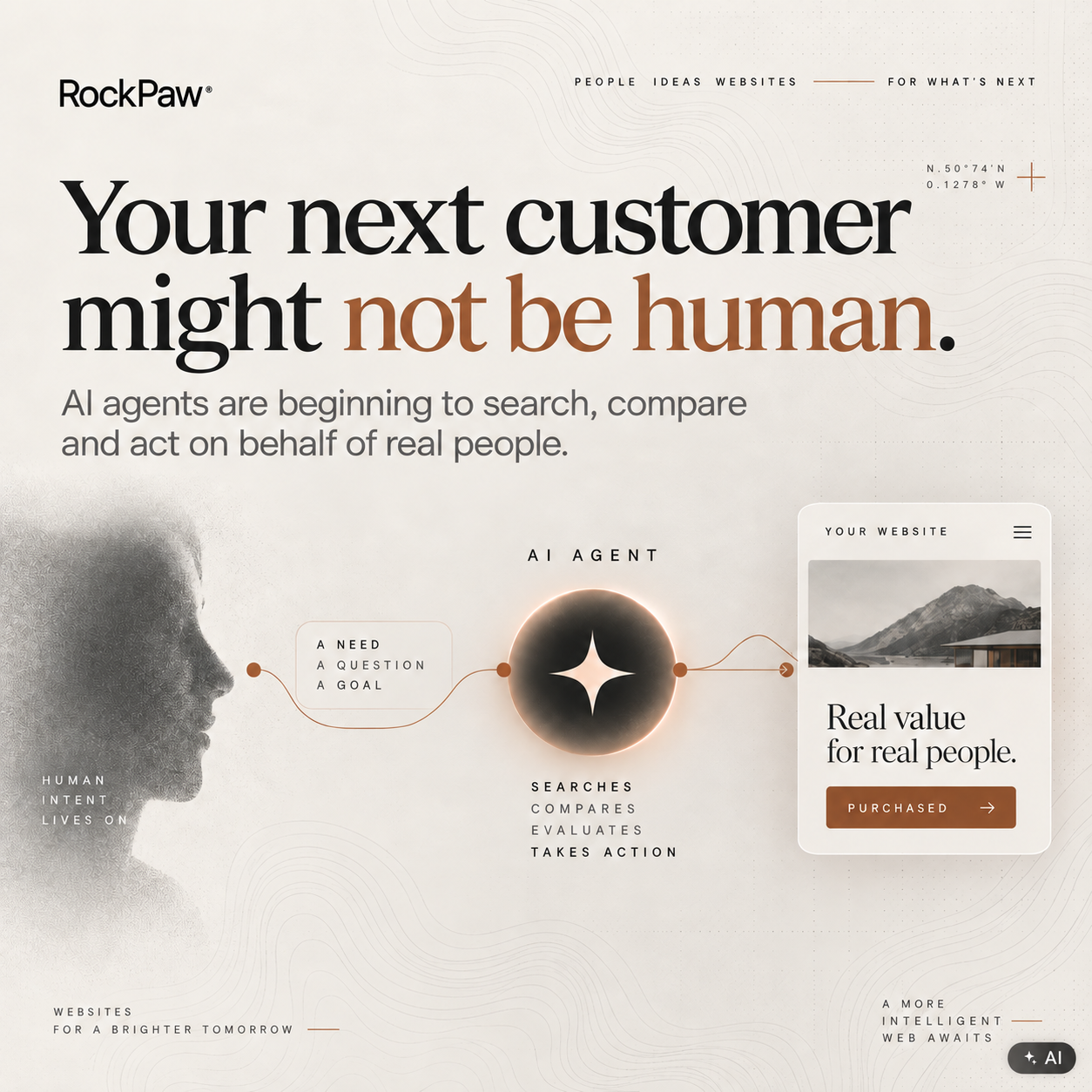
Your next customer might not be human.
AI agents are beginning to search, compare and act on behalf of real people. Is your website ready for them?
For years, websites have been designed around one assumption: a person will arrive, look around and decide what to do next.
That assumption is changing.
Cloudflare recently reported that automated systems accounted for around 57% of web-page traffic across its network.
Much of that traffic is familiar — search engines, crawlers and automated services. But one of the fastest-growing areas is very different: AI agents acting on behalf of real people.
And that could have a significant impact on the way businesses design, structure and operate their websites.
From searching to doing
We’re already used to asking AI to find information. Increasingly, AI will be asked to do something with it.
Find the best option. Compare suppliers. Check availability. Recommend a product. Make a booking. Place an order.
A potential customer may never browse your website in the traditional sense. Instead, their AI assistant could evaluate your business alongside several competitors and decide which one best meets their requirements.
That raises an important question:
Can an AI agent understand your website well enough to choose you?
Being found may no longer be enough.
Businesses have spent years thinking about SEO. Then mobile usability. Then social discovery. AI introduces a new consideration.
Your website needs to be understandable not only to the person viewing it, but increasingly to the intelligent systems acting on their behalf.
Can an agent clearly determine:
- What you offer?
- Who it’s for?
- What makes you different?
- What it costs or how to buy?
- What action should happen next?
A website might look excellent to a human visitor while remaining surprisingly difficult for an AI system to interpret or interact with.
And if your competitor makes that information easier to understand and act upon? Which business is the agent more likely to recommend?
The competitive advantage could be invisible.
Imagine two companies offering broadly comparable products or services. Both have attractive websites. Both rank well. Both appear credible.
But one has a digital platform that makes its products, services, pricing, availability and next steps easy for AI systems to understand. The other doesn’t.
To a person, the difference might be difficult to see. To an AI agent, it could be significant.
This isn’t about designing websites for robots.
Good human UX still matters. In fact, many of the things that make a website easier for AI to understand also make it better for people:
- Clearer information.
- Better structure.
- Logical navigation.
- Accurate product and service data.
- Useful search.
- Connected systems.
- Clear actions.
The difference is that websites may increasingly need to work for both people and the intelligent agents acting for them.
So, is your website ready?
The shift towards AI-assisted search, comparison and commerce is already underway.
The bigger question is whether your digital platform is prepared for it — or whether your competitors will become easier for AI to understand, recommend and ultimately transact with.
And that creates a very different question from: “Does our website look good?”
Is your website ready for the way your customers may buy next?
At RockPaw, we’re exploring how websites, e-commerce platforms and digital ecosystems need to evolve as the relationship between people, AI and businesses changes.